

Access Control vs. Keyed Locks: The Five-Year Cost
June 15th, 2027
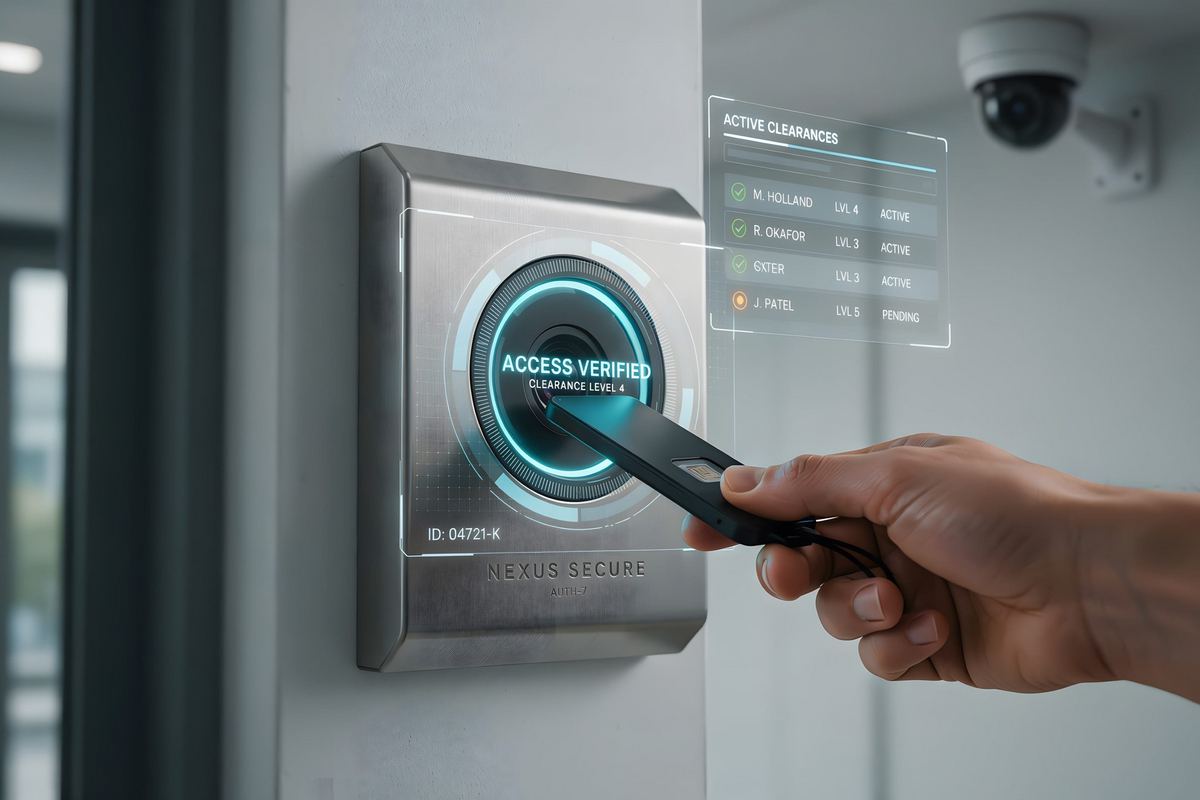
The quote for electronic access control is always larger than the quote for rekeying a building. That comparison is misleading, because it compares a five-year system to a one-week project. The mechanical option looks cheap because most of its cost arrives later, as small invoices nobody totals.
This is the honest version of the comparison, using a realistic small commercial building. The numbers are illustrative and vary with door count, hardware, and construction, but the shape of the answer holds.
The Scenario
A professional office building with 18 exterior and interior doors, 40 employees, and a turnover rate of roughly 20 percent per year. That is eight departures and eight hires annually, plus contractors, cleaners, and the usual contractor traffic. The business wants controlled access on the front door, a server room, a cash office, and a records room, with basic coverage elsewhere.
What Mechanical Keys Cost
Initial
A good commercial master key system with restricted keyways, pinned cylinders, and documented hierarchy runs roughly $3,000 to $6,000 for 18 doors, depending on hardware condition. Keys themselves are a modest line item, perhaps $15 to $40 each for restricted keys, with two or three per employee.
Annual operating
The ongoing costs are the ones that get missed.
- Keys for new hires. Eight new employees a year, two to three keys each. Small, but it happens forever.
- Lost key rekeys. Industry practice suggests a few lost keys per year in an organization this size. If a lost key is a master-level key, the affected doors are rekeyed. If it is a change key, one door. Budget a few hundred to a couple of thousand per year.
- Turnover rekeys. Some businesses rekey on every departure. At 18 doors and eight departures, doing this fully is unaffordable, so most businesses do not, which means keys stay in circulation.
- Administration time. Someone tracks issuance, chases returns, calls the locksmith, and handles the inevitable "who has a key to the file room" question. Usually a few hours a month, often unmeasured.
- Undocumented copies. Every copied key is a future rekey. Restricted keyways reduce this sharply and are the single most important mechanical control.
Five-year total
For this scenario, mechanical access typically lands somewhere between $8,000 and $14,000 over five years, with the range driven mostly by how disciplined the key control actually is. Businesses that rekey after every lost key spend at the top of that range. Businesses that never rekey spend less and carry unknown exposure.
What Electronic Access Control Costs
Initial
Electronic access control has a higher floor because every door needs hardware, power, and a path to the controller.
- Reader and controller hardware per door
- Electric strike or maglock and door position sensor
- Request-to-exit device for code compliance
- Power supply and battery backup
- Cabling, which is the wildcard. A door near a ceiling with existing conduit is inexpensive. A masonry wall with no path is not.
- Installation labor, including door hardware work
- Software or cloud subscription, usually per door per month
A realistic per door range for a commercial retrofit in this region is roughly $1,500 to $3,000, with the higher end driven by door hardware and cabling. For four doors, that is roughly $6,000 to $12,000. For all 18, the number climbs quickly, which is why most businesses phase the work.
Annual operating
- Subscription or software maintenance. Modest per door.
- Credentials. Cards or fobs cost a few dollars each and are far cheaper than restricted keys.
- Battery replacement in power supplies and locks, on a schedule.
- Service calls for hardware faults, which are less frequent than people expect but not zero.
- Administration time. Much lower. A departing employee is disabled in the software in under a minute.
Five-year total
For four doors, five-year electronic cost typically lands between $9,000 and $16,000. For a phased buildout that grows to eight or ten doors over the period, it approaches the mechanical range and sometimes comes in below it once rekeying, key administration, and lost key incidents are counted honestly.
The Costs That Do Not Show Up in Either Quote
What mechanical keys cannot do
- Revoke access instantly when someone leaves
- Restrict access by time of day
- Produce an audit trail of who entered which door and when
- Prevent a key from being copied
- Lock a door remotely
- Enforce two-person rules for sensitive rooms
What electronic access cannot do
- Work indefinitely without power or a maintained battery
- Survive a network or controller failure without a local decision at the door
- Protect a door whose frame, closer, or strike is failing
- Guarantee that the door was actually closed
- Eliminate the need for a mechanical key as a backup, because there is always a fire service key and usually a building key
Electronic access is a system, and systems need power, network, and maintenance. A building that installs readers and then stops maintaining the batteries is worse off than one with good mechanical hardware, because the doors fail in the wrong direction.
The Hybrid Design Most Businesses Should Choose
Very few businesses need to convert every door, and very few are well served by staying entirely mechanical. The design that usually wins:
- Electronic on the doors that matter. Main entrance, server room, cash handling, records, any door with regulatory or insurance relevance, and any door where after-hours access needs a record.
- Mechanical master keying everywhere else. Individual offices, storage, and low-traffic interior doors.
- Restricted keyways on the mechanical side. This is the single highest-value mechanical upgrade and it costs far less than converting doors.
- One credential strategy. A card that opens electronic doors, and a key on the same ring for mechanical doors, with a documented record of what each person holds.
This produces most of the security benefit of a full electronic system at a fraction of the cost, and it leaves the door open to convert more doors later as budget allows.
How to Run the Numbers for Your Building
Four inputs produce a defensible comparison:
- Door count, classified. Which doors are electronic candidates and which are fine mechanical.
- Turnover and lost key rate. Use last year's actual numbers, not an industry average.
- Current rekey spending. Pull the invoices from the last two years. Most businesses discover they spend more than they thought.
- Audit requirements. Any door where an insurer, a regulator, or a client requires evidence of access belongs on the electronic list regardless of cost.
Run the comparison over five years, not one. The mechanical option wins on year one and loses on year five in almost every case where turnover is real and at least one door needs an audit trail.
Where iTech Fits
iTech provides commercial locksmithing services in Parkersburg WV and installs access control as part of the same work, so the comparison is not a choice between two vendors with an incentive to favor their own product. We survey the doors, document the hardware, and propose the mix that fits the building.
If a master key system is the starting point, our article on designing a master key system covers the hierarchy. To compare options for your building, contact us for a survey.
Posted in: Locksmithing